Dr. Sears Immunization schedule. This an example of what you can do, except thrown out the rotovirus vax. Only 1-2 shots at a time. 2 months: DTaP, Rotavirus
The big question for new parents was to either breastfeed or formula feed, but now a days with concern over side effects of vaccination and supposed link to autism; the bigger question remains, should you vaccinate your child?
For some states such as Mississippi and West Virginia, there is no
choice for parents to make, it’s a resounding yes. But over 20 states
allow children to be unvaccinated and almost all states allow
unvaccination for religious reasons. With my concern over recent controversy of vaccines (especially MMR) being linked to autism, I ordered The Vaccine Book by Dr. Robert Sears. The book itself offer invaluable resource over each vaccination including: Dr. Sears tries to offer a balanced
approach and offers information that can be reassuring to concerned
parents. It even offers a vaccination schedule that a very anti-vaccine
parent might even consider. There is also an alternative (and perhaps
even safer) vaccine schedule for parents who wants their child to be
fully vaccinated but want to minimalize side effects and the risk.
According to Dr Sears, I have put together a vaccine schedule that gets children
fully vaccinated, but does so in a way that minimizes the theotetical
risk of vaccines. It’s the best of both worlds of disease prevention
and safe vaccination. The book also addresses the issue is vaccination a social
responsibility or personal choice? I really love the non-judgemental and
almost impartial stance the book takes which allows the parents to make
an informed decision that’s not colored by the authors objective. Just
for the alternative vaccine schedule alone; I would highly recommend
this book. The book is well medically researched but not so complicated
that it would overwhelm a sleep deprived parents who are still concerned
about the well-being of their newborn. To Vaccinate or Not to Vaccinate? Now that the measles, mumps and rubella vaccines are combined into
one shot, the MMR vaccine, avoiding those mega doses of vaccinations in
one visit is a little harder. With a little ingenuity however, you can
have the shot for each disease administered separately.
Dr. Bob Sears, son of the well known parenting expert, “Dr. Sears,”
(Dr. Bob is the author of The Vaccine Book in the Sears Parenting
Library Series) has some recommendations if you choose to go this route. As the connection between vaccines and a host of illnesses, including
asthma and autism remains fuzzy, parents should continue exercising
caution in vaccinating their children. It’s nice to know there are some
options. Related content: The Vaccine Book
is divided into 19 chapters. The first 12 chapters are devoted to a
different vaccine. Within each vaccine chapter, Dr. Sears discusses: The last section of each chapter is my favorite, as it cuts to the
chase of what I am wanting to know as a parent. “The Way I See It”
describes the public and personal health reasons why a parent should or
should not consider a vaccine. For example, Dr. Sears writes about the
polio vaccine: Since polio was eradicated from the United States more
than twenty years ago and isn’t even found on this half of the planet,
it is safe to say that we don’t give this vaccine in order to protect
each individual child from catching polio…I consider this vaccine very
important from a public health viewpoint. Until the whole world is polio
free, ongoing vaccination will help keep our nation protected “from sea
to shining sea.” The remaining chapters of The Vaccine Book
discusses combination vaccines, safety research, side effects,
ingredients, myths and questions, information for parents who chose to
delay or decline vaccines (including Dr. Sears’ selective vaccination
schedule), and “What Should You Do Now?” I am very pleased to see that
Dr. Sears’ selective vaccination closely matches my family’s choices,
with the exception of rotavirus. His advice has matched those of my own
pediatrician and doctors, and it is reassuring to have this resource
when considering any vaccine for your child.Dr. Robert (Bob) W. Sears is
the son of the infamous Dr. William (Bill) Sears, best known for promoting Attachment Parenting. To visit Dr. Bob’s vaccine blog, click here.
This blog is updated with recent vaccine news, such as the Merck
recall, as well as resources for doctors and families seeking
“vaccine-friendly” doctors. There are so many issues involving
vaccinations, such as state requirements and the use of animal/human
tissue, that Dr. Sears does an amazing job covering the subject. As a
friend of mine who is a pediatric nurse practitioner explained to me,
“Your child will probably be fine if you vaccinate; your child will
probably be fine if you don’t vaccinate.” Of course, this statement
applies to children in the United States.
3 months*: Pc, HIB
4 months: DTaP, Rotavirus
5 months*: Pc, HIB
6 months: DTaP, Rotavirus
7 months*: Pc, HIB
9 months: Polio
12 months: Mumps, Polio
15 months: Pc, HIB
18 months: DTaP, Chickenpox
2 years: Rubella, Polio
2 1/2 years*: Hep B, Hep A (start Hep B at birth if any close relatives or caregivers have Hep B)
3 years: Hep B, Measles
3 1/2 years*: Hep B, Hep A
4 years: DTaP, Polio
5 years: MMR
6 years: Chickenpox
12 years: Tdap, HPV
12 years, 2 months*: HPV
13
years: HPV, Meningococcal (once Meningococcal vaccine is approved for
age 2, Dr. Sears will move it there and delay Hep B by 6 months)The Vaccine Book by Dr. Sears Offers A Safer Vaccine Schedule


Related post on Dr. Sears and vaccines:
 Like many of us, the more you learn about vaccines the more you run up against the perplexing question: To Vaccinate or Not to Vaccinate. Like me, you may have decided to vaccinate but not on schedule and not multiple vaccines at one time.
Hello there! If you are new here, you might want to subscribe to the RSS feed for updates on this topic.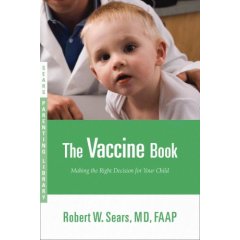 Thus far, I have avoided the topic of vaccinations on Eco Child’s Play
for several reasons. I am not a doctor, nor would I ever want to
pretend that I know more than someone who has gone to medical school.
Also, much of the information I know about vaccinations is outdated
(like the presence of thimerosal
in all of the childhood vaccines). Lastly, my family’s choices have
changed over time, from being staunchly opposed to any vaccinations to
picking and choosing protection for our children based upon our son’s
congenital heart defect. Finally, I feel like there is a
straightforward, quality resource for parents in Dr. Sears’ The Vaccine Book: Making the Right Decision for Your Child. I wish I would have had this book six years ago, when my first child was born.
Thus far, I have avoided the topic of vaccinations on Eco Child’s Play
for several reasons. I am not a doctor, nor would I ever want to
pretend that I know more than someone who has gone to medical school.
Also, much of the information I know about vaccinations is outdated
(like the presence of thimerosal
in all of the childhood vaccines). Lastly, my family’s choices have
changed over time, from being staunchly opposed to any vaccinations to
picking and choosing protection for our children based upon our son’s
congenital heart defect. Finally, I feel like there is a
straightforward, quality resource for parents in Dr. Sears’ The Vaccine Book: Making the Right Decision for Your Child. I wish I would have had this book six years ago, when my first child was born.
- Home
- Products
- healthy lifestyles
- Northern Edge
- What is flaxseed and Wheat germ
- Blood Type diet
- Alkiline
- 21 day challenge
- house rules
- Recipes
- Gods Pharmacy
- Kitchen Make-over
- Testimonials
- Exercise your health
- Top 10 things to buy organic
- why organic
- aspirtime
- rbgh in milk
- Food to buy organic
- Allergies
- caffiene
- Immunizations for children
- Delayed cord clamping debate after birth
